
A glockenspiel has metal bars and a xylophone has wooden bars. That one difference explains almost everything else: the glockenspiel rings like small bells and sounds very high, while the xylophone gives a short, dry, woody knock. Both are laid out like a piano keyboard and both are played with mallets, so a player who knows one can find the notes on the other straight away.
Glockenspiel vs xylophone at a glance
| Feature | Glockenspiel | Xylophone |
|---|---|---|
| Bars | Steel, sometimes aluminium on student models | Wood such as rosewood or padauk, or a synthetic substitute |
| Sound | Bright, bell-like, long ring | Sharp, dry, short decay |
| Typical range | About 2.5 octaves | About 3.5 to 4 octaves |
| Pitch | Sounds two octaves higher than written | Sounds one octave higher than written |
| Resonators | Usually none on orchestral models | A tube under each bar |
| Mallets | Hard: brass, plastic, or hard rubber | Hard rubber, plastic, or wood |
| Size | Small enough to carry under one arm | A full-size frame on a stand |
| Name means | “Bell play” in German | “Wood sound” in Greek |
The bars: metal vs wood
Glockenspiel bars are thin strips of steel. Metal is dense and loses energy slowly, so each note keeps ringing after it is struck. Xylophone bars are thick pieces of hardwood, traditionally rosewood. Wood absorbs the vibration quickly, which is why a xylophone note is over almost as soon as it starts.
Many school and budget xylophones use a synthetic bar instead of rosewood. They hold their tuning well and cope better with changes in humidity, at the cost of a slightly less warm tone.
How they sound
The glockenspiel is one of the highest instruments in the orchestra. Its notes are pure and glassy and they cut through a full ensemble with very little effort. Composers use it for sparkle: a melody doubled on glockenspiel sounds as if it has been outlined in light.
The xylophone is brighter and more percussive than it is sweet. Because each note dies away quickly, fast runs stay clean and every note is heard separately. That makes it a natural choice for quick, playful, or dramatic passages.
Range and pitch
An orchestral glockenspiel usually covers about two and a half octaves and sounds two octaves above the written notes. A concert xylophone covers three and a half to four octaves and sounds one octave above written. In practice the xylophone reaches much lower, and the glockenspiel lives at the very top.
Mallets and playing technique
Both instruments need hard mallets, because a soft mallet cannot bring out such high notes. Glockenspiel players use brass, hard plastic, or hard rubber heads. Xylophone players use hard rubber, plastic, or wooden heads. Brass mallets should never be used on a xylophone because they dent the wood.
Since a glockenspiel note keeps ringing, players often damp bars with a finger to stop notes blurring together. On a xylophone the opposite problem applies: to hold a long note the player has to roll, striking the bar rapidly with alternating mallets. For more on mallets, see what you hit a glockenspiel with.
Where each one is used
- Glockenspiel: orchestras, concert bands, and marching bands, where an upright version called the bell lyre is carried on parade. Small diatonic glockenspiels are also standard in primary school music rooms.
- Xylophone: orchestras, concert bands, ragtime and novelty music, and school classrooms, where larger bass, alto, and soprano xylophones are used for ensemble work.
Is a toy xylophone really a xylophone?
Usually not. The colourful instrument with metal bars that most children are given is, strictly speaking, a glockenspiel. A true xylophone always has wooden or wood-substitute bars. The name has simply stuck to the toy.
Which one should you buy?
- For a young child: a small glockenspiel. It is compact, inexpensive, stays in tune, and sounds pleasant even when hit hard.
- For a percussion student: a glockenspiel, often sold as a bell kit, is the usual first mallet instrument for school band. A xylophone comes later.
- For the classic woody sound: a xylophone. Nothing with metal bars will give you that tone.
You can compare current models here: glockenspiels on Amazon and xylophones on Amazon. As an Amazon Associate we earn from qualifying purchases.
How they relate to other mallet instruments
The glockenspiel and xylophone are two members of a larger family. If you are sorting out the rest, these guides help:
- Glockenspiel vs metallophone
- Xylophone vs vibraphone vs marimba
- Bells vs glockenspiel
- Celesta vs keyboard glockenspiel
FAQs
Is a glockenspiel a type of xylophone?
No. They are separate instruments in the same family. A glockenspiel has metal bars and a xylophone has wooden bars.
Which is easier to learn, glockenspiel or xylophone?
They are equally easy to start on because the note layout is the same. The glockenspiel is smaller, so the notes are closer together, which suits children.
Can you play xylophone music on a glockenspiel?
Yes, as long as the notes fit the smaller range. It will sound higher and will ring where the xylophone would be short and dry.
Which is louder?
Both carry well. The glockenspiel’s very high pitch makes it easy to hear over a whole orchestra, while the xylophone’s sharp attack gives it presence in fast passages.
What is the difference between a glockenspiel and a marimba?
A marimba has wooden bars like a xylophone but is much larger, lower, and warmer, with long resonator tubes. A glockenspiel is small, metal, and very high. See whether a glockenspiel and marimba use the same notes.


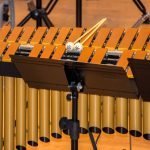

[…] More About: Glockenspiel vs Xylophone: What’s the Difference? […]
[…] Xylophone and Glockenspiel are similar percussion instruments but with slight differences in sound and design. […]
[…] main difference between a Glockenspiel and a xylophone is the material used for the bars. The bars on a Glockenspiel are made of metal, while the bars on […]
[…] are the xylophone, glockenspiel, and […]
[…] For the full wood-versus-metal comparison, see glockenspiel vs xylophone. […]
[…] the mallet version, see glockenspiel vs xylophone and glockenspiel vs […]