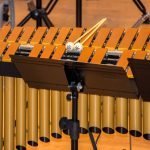
The celesta and the keyboard glockenspiel are both played from a piano-style keyboard, and both strike metal with hammers. The difference is in what the hammers hit and what sits behind it. A celesta has felt hammers and steel plates set over wooden resonators, so it sounds soft, round, and sweet. A keyboard glockenspiel has harder hammers and bars with no resonators, so it sounds brighter and more piercing.
What is a Celesta?
The celesta looks like a small upright piano. Pressing a key throws a felt-covered hammer against a steel plate, and a wooden resonator under the plate warms and rounds the note. It was invented in Paris by Auguste Mustel and patented in 1886. A sustain pedal lets the notes ring on.
Its best-known moment is the “Dance of the Sugar Plum Fairy” in Tchaikovsky’s The Nutcracker. More recently it carries the opening of “Hedwig’s Theme” in the Harry Potter films.
What is a Keyboard Glockenspiel?
A keyboard glockenspiel is a glockenspiel played from a keyboard instead of with hand-held mallets. The keys work small hard hammers that strike metal bars directly. With no resonators to soften it, the tone is brilliant and bell-like. Mozart wrote for an instrument of this kind in The Magic Flute, where it plays Papageno’s magic bells.
What are the Differences between a Celesta and a Keyboard Glockenspiel?
| Feature | Celesta | Keyboard glockenspiel |
|---|---|---|
| Hammers | Felt-covered | Hard |
| What they strike | Steel plates over wooden resonators | Metal bars, no resonators |
| Tone | Soft, round, music-box sweet | Bright, sharp, bell-like |
| Range | Usually four to five and a half octaves | Usually about two and a half to three octaves |
| Pedal | Sustain pedal | Often none |
| First appeared | 1886 | 18th century |
Celesta vs glockenspiel: which one is in the score?
Orchestras often swap between three instruments for bell-like parts. A standard glockenspiel is played with mallets by a percussionist. A keyboard glockenspiel and a celesta are played by a keyboard player. When a part has fast runs or chords that are awkward with two mallets, it usually goes to one of the keyboard instruments. When the composer wants softness, it goes to the celesta.
For the mallet version, see glockenspiel vs xylophone and glockenspiel vs metallophone.
Is celesta a keyboard?
Yes. It has black and white keys like a piano and is played by a pianist. Because its sound comes from struck metal, it is classed as a percussion instrument, but in an orchestra it sits with the keyboards.
What is the keyboard version of a glockenspiel?
The keyboard glockenspiel. The celesta is its softer, later relative. The vibraphone is sometimes suggested, but it is a mallet instrument with no keyboard.
Is a glockenspiel a keyboard instrument?
The ordinary glockenspiel is a mallet percussion instrument. Its bars are laid out in the same pattern as piano keys, which is why percussionists call this family “keyboard percussion”, but there are no keys to press.
What is the difference between a celesta and a piano?
A piano’s hammers strike strings. A celesta’s hammers strike steel plates. The celesta is much quieter, has a shorter range, and has a pure, chiming tone where the piano is full and resonant.
FAQs
Can you play chords on a celesta or a keyboard glockenspiel?
Yes. Both have a full keyboard, so chords are as easy as on a piano.
Are celestas expensive?
Yes. They are specialist instruments made by only a few builders, and a new one costs many thousands of dollars. Most players meet one in an orchestra or use a sampled celesta on a digital keyboard.
Do you need special training to play one?
If you can play the piano you can play either. The touch is lighter and the notes speak differently, so it takes a little time to adjust.